Short answer
The best things to do in Lucerne are walking the Chapel Bridge and the old town, seeing the Lion Monument, climbing the Musegg wall towers (open in the warm season), taking a paddle steamer on Lake Lucerne, and riding up Mount Pilatus or the Rigi for the view. Two days covers the city and one mountain; add a third if the weather is uncertain.
On this page 9 sections
Lucerne packs a medieval old town, a lake ringed by mountains and two famous summits into a city you can cross on foot in 20 minutes. Most of the classic sights are within a short walk of the station, and the lake boats leave right in front of it, so a day here can start on a covered bridge and end on a mountaintop.
Here's what to do, grouped by type, with a 2-day plan at the end.
Lucerne at a glance
| What | Time | Cost | Season |
|---|---|---|---|
| Chapel Bridge and old town | 2 hours | Free | Year-round |
| Lion Monument | 20 minutes | Free | Year-round |
| Musegg wall towers | 1 hour | Free | Spring to autumn |
| Lake cruise | 1–3 hours | $$ | Year-round (more boats in summer) |
| Mount Pilatus | Half to full day | $$$ | Cogwheel: May to November |
| Mount Rigi | Half to full day | $$$ | Year-round |
| Swiss Museum of Transport | Half day | $$ | Year-round |
| Rosengart Collection | 1–2 hours | $$ | Year-round |
The old town
1. Walk across the Chapel Bridge
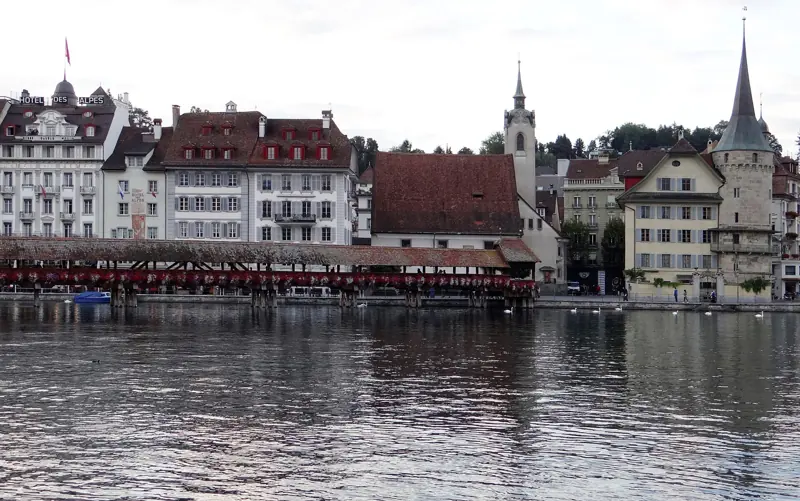
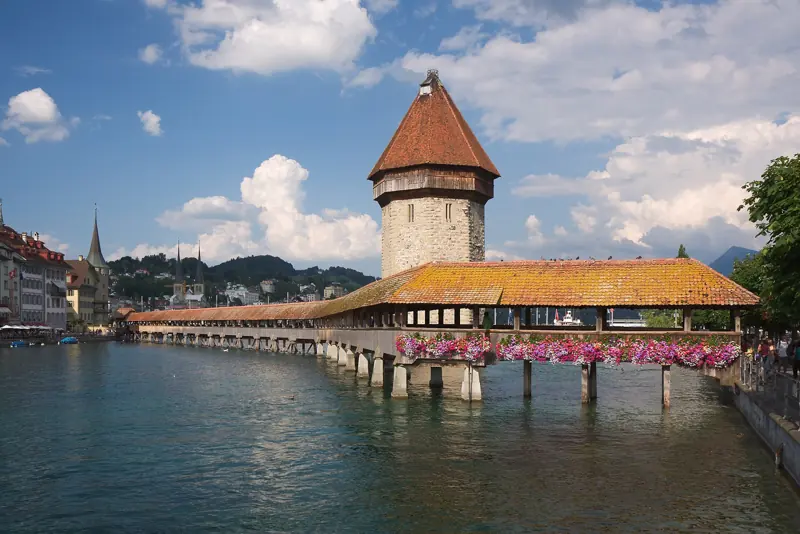
The Chapel Bridge (Kapellbrücke) crosses the Reuss at an angle and is the symbol of Lucerne. It dates from the 14th century and is often described as the oldest covered wooden bridge in Europe. Look up at the triangular paintings under the roof: many were lost in a fire in 1993, and a few charred panels were left in place after the bridge was restored. The stone Water Tower beside it is older than the bridge.
2. Find the Spreuer Bridge and its Dance of Death
Five minutes downstream, the Spreuer Bridge is the Chapel Bridge's quieter sibling, dating from 1408. Its 17th-century paintings by Kaspar Meglinger show a Dance of Death, with Death joining people from every walk of life. Few tourists get this far, and the view upstream toward the old town is one of the best in the city.
3. Wander the squares on the right bank
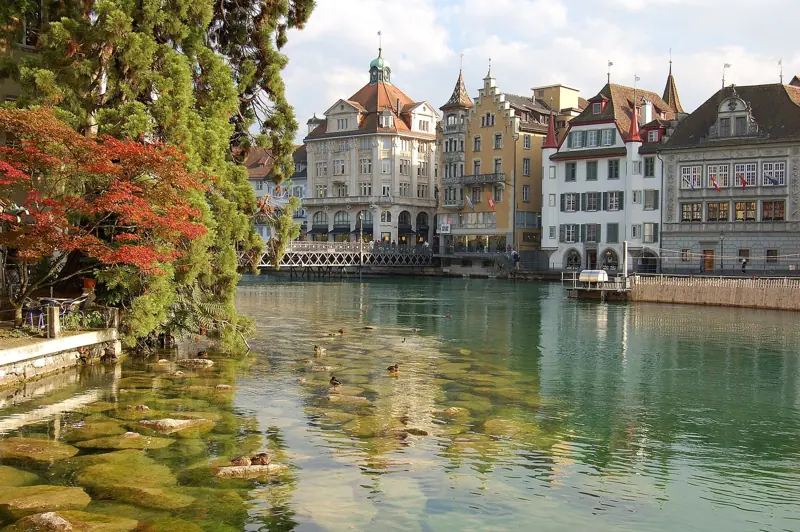
The Weinmarkt, the Kornmarkt and the Hirschenplatz are lined with painted façades and guild houses. Walk them without a plan, then cross back over the Rathaussteg footbridge. On Tuesday and Saturday mornings, a market fills the riverbanks.
4. Climb the Musegg wall towers
Nine towers along the old city wall overlook the roofs of the old town, and four of them are usually open to the public from spring until about the start of November, for free. The Zyt tower has the oldest clock in the city, and by tradition it strikes the hour one minute before all the others. Be up there just before the hour to hear it.
5. See the Lion Monument
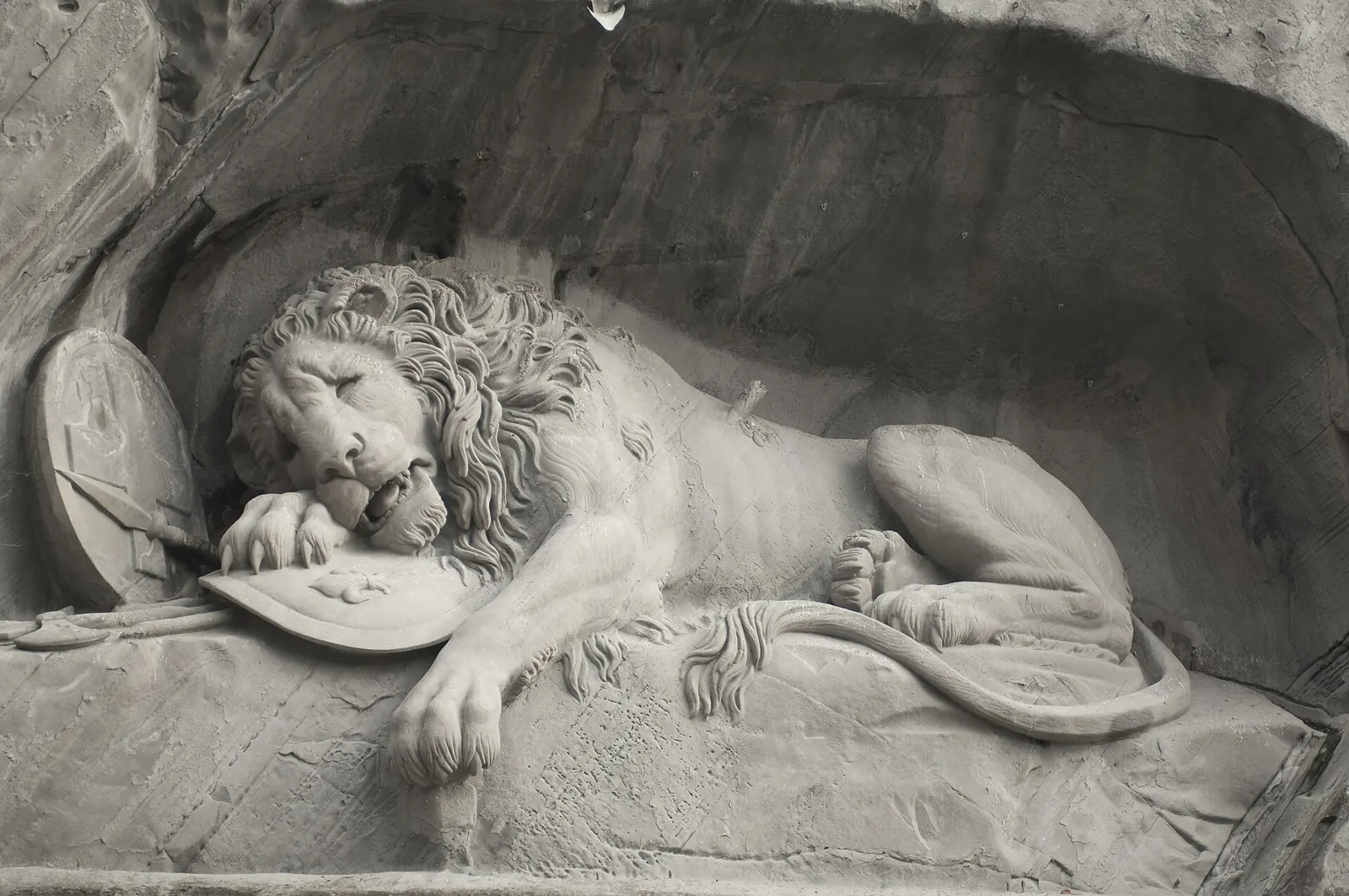
A dying lion carved into a sandstone cliff, the Lion Monument commemorates the Swiss Guards killed in Paris in 1792, during the storming of the Tuileries. It was carved in the early 1820s and sits in a small, shaded park about 10 minutes' walk from the Chapel Bridge. The Glacier Garden, with its ancient potholes carved by the ice, is right next door.
On the lake
6. Take a paddle steamer
The Lake Lucerne boats include five historic paddle steamers from the Belle Époque, alongside modern motor ships. They leave from the piers in front of the station. A round trip to Weggis or Vitznau takes about two to three hours, and even a one-hour loop gives you the city skyline with Pilatus behind it. The Swiss Travel Pass covers the regular boats; check the timetable to find a sailing by steamer.
7. Walk the lakefront promenade
From the KKL concert hall, follow the Schweizerhofquai and the Haldenstrasse east past the grand hotels. It's a flat, easy walk along the water, about 25 minutes to the Swiss Museum of Transport, and the best way to see Lucerne's Belle Époque side.
The mountains
8. Ride up Pilatus
The Pilatus cogwheel railway climbs from Alpnachstad, on the lake, to Pilatus Kulm at 2,132 m (6,995 ft), with gradients of up to 48%, the steepest in the world. It runs from about mid-May to November and takes about 30 minutes up. From the summit, a panoramic gondola and an aerial cableway descend toward Kriens, where a city bus takes you back to Lucerne. In summer, the "Golden Round Trip" links the boat, the cogwheel train and the cable cars in a loop.
9. Spend a day on the Rigi
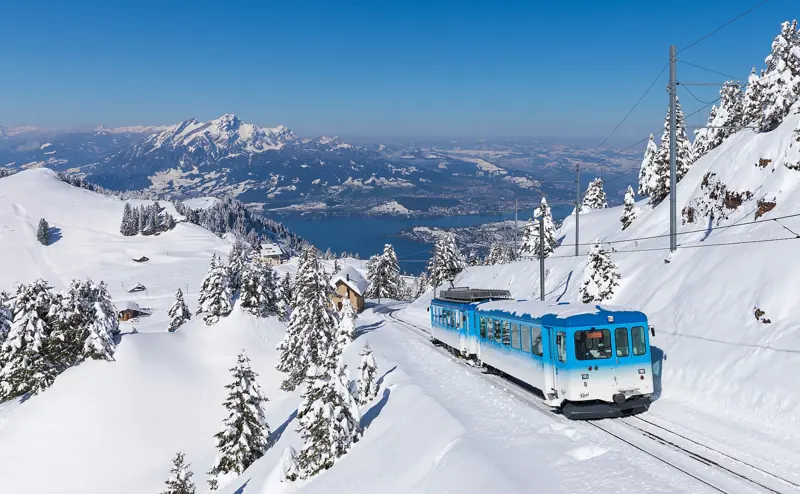
The Rigi is the gentler of Lucerne's two mountains. Take the boat to Vitznau, then Europe's first mountain railway up to Rigi Kulm at 1,798 m (5,899 ft). The views stretch over several lakes, and the walk down to Rigi Kaltbad is one of the easiest summit walks in Switzerland: see our Rigi Kulm to Kaltbad hike. The Rigi is fully covered by the Swiss Travel Pass and runs year-round.
10. Ride an open-top cable car up the Stanserhorn
From Stans, about 20 minutes from Lucerne by train, a historic funicular and the CabriO cable car, with an open upper deck, climb to the Stanserhorn. The season usually runs from April to November. It's a good alternative when Pilatus is busy.
Museums and rainy days
11. Spend half a day at the Swiss Museum of Transport
Switzerland's most visited museum covers trains, planes, boats, cars and space travel, with a planetarium and plenty for kids to climb into. It's open every day of the year, usually 10 am to 5 or 6 pm depending on the season. Walk there along the lake or take a bus.
12. See the Rosengart Collection
Near the station, this private collection is best known for its works by Pablo Picasso and Paul Klee, along with other modern masters. It's a calm hour or two when the mountains are in cloud.
Soak after
13. Swim in the mineral bath on the Rigi
Lucerne doesn't have a thermal bath of its own, but the Rigi has the next best thing: Mario Botta's mineral bath at Rigi Kaltbad, at 1,440 m, with an outdoor pool facing the Alps. Combine it with the Rigi day. Back in the city, the Mandarin Oriental Palace has a spa on the lakefront, and the Bürgenstock resort, by boat and funicular across the lake, has an infinity pool over the water.
Rigi Kaltbad Mineral Baths & Spa
Rigi Kaltbad · Lucerne
Why go: Mario Botta's mountain mineral bath at 1,440 m, reachable only by cogwheel train or cable car.
Mandarin Oriental Palace, Luzern
Lucerne · Lucerne
Why we picked it: Restored lakefront palace hotel with a spa, walking distance to the old town.
Check rates & availability →Bürgenstock Hotels & Resort
Bürgenstock · Nidwalden
Why we picked it: Clifftop resort with a 10,000 m² Alpine Spa and an infinity pool over Lake Lucerne.
See rates nearby →Lucerne in 2 days
| Day | Morning | Afternoon |
|---|---|---|
| 1 | Chapel Bridge, Spreuer Bridge, old town squares | Musegg wall, Lion Monument, evening lake cruise |
| 2 | Boat to Vitznau, train to Rigi Kulm | Walk to Rigi Kaltbad, mineral bath, cable car to Weggis and boat back |
Day 1: the city
Start at the Chapel Bridge before the crowds, then walk downstream to the Spreuer Bridge and back up through the old town squares. Climb the Musegg wall before lunch (in season), and walk down to the Lion Monument. In the late afternoon, take a one-hour boat loop for the skyline and the sunset over Pilatus.
Day 2: the Rigi
Take a morning boat to Vitznau (about an hour), then the cogwheel train to Rigi Kulm. Walk down to Rigi Kaltbad, have lunch and spend an hour in the mineral bath. Ride the cable car down to Weggis and catch the boat back to Lucerne. With a third day, swap in Pilatus, or take the train to Engelberg for Mount Titlis. Our day trips from Zurich guide also works from Lucerne for Zug and the lake towns.
Arriving from Zurich, direct trains take about 45 to 50 minutes. If you're still deciding where to base yourself, read our Interlaken vs Lucerne comparison, and for the full route, see our Switzerland itinerary. In winter, add the Lucerne Christmas market.
Where to stay
Stay in the old town or near the station for a first visit: everything above starts within a 10-minute walk. Our guide to where to stay in Lucerne compares the old town, the station area, the lakefront and the lake villages, with hotels for each.
Hotel Des Alpes Luzern
Lucerne
Why we picked it: On the Reuss right next to the Chapel Bridge, about 3 minutes' walk from the station and the lake boats.
Check rates & availability →Hotel Monopol Luzern
Lucerne
Why we picked it: Directly opposite Lucerne station, so you can walk off the train with your bags; the old town is a few minutes away.
Check rates & availability →Hotel Schweizerhof Luzern
Lucerne
Why we picked it: Grand hotel on the lake promenade, run by the same family since 1861, about 5 minutes' walk from the station across the bridge.
Check rates & availability →See hotels in Lucerne old town →
Frequently asked questions
How many days do you need in Lucerne?
Two days is enough for most visitors: one for the old town, the Lion Monument and a lake cruise, one for Pilatus or the Rigi. Add a third day if you want both mountains or a spare day in case of clouds.
Is Pilatus or the Rigi better from Lucerne?
Pilatus is more dramatic, with the steepest cogwheel railway in the world and a rocky summit at 2,132 m. The Rigi is gentler, has more easy walks and a mineral bath at Rigi Kaltbad, and is fully covered by the Swiss Travel Pass, while Pilatus usually gives a discount.
Is the Swiss Travel Pass valid on Lake Lucerne boats?
Yes, on the regular boat services listed in the timetable, including the historic paddle steamers. Special cruises with meals and the Saphir panorama yacht are extra.
What is there to do in Lucerne in winter?
Walk the old town and the bridges, visit the Swiss Museum of Transport or the Rosengart Collection, take a short boat ride, and soak at Rigi Kaltbad. Pilatus's cogwheel railway closes in winter, but the cable cars from Kriens usually run outside maintenance periods. From late November, there's also the Christmas market.